


Guyana’s oil production has climbed from a standing start in December 2019 to over 900,000 barrels per day in just over six years, marking one of the fastest offshore production ramp-ups in history.
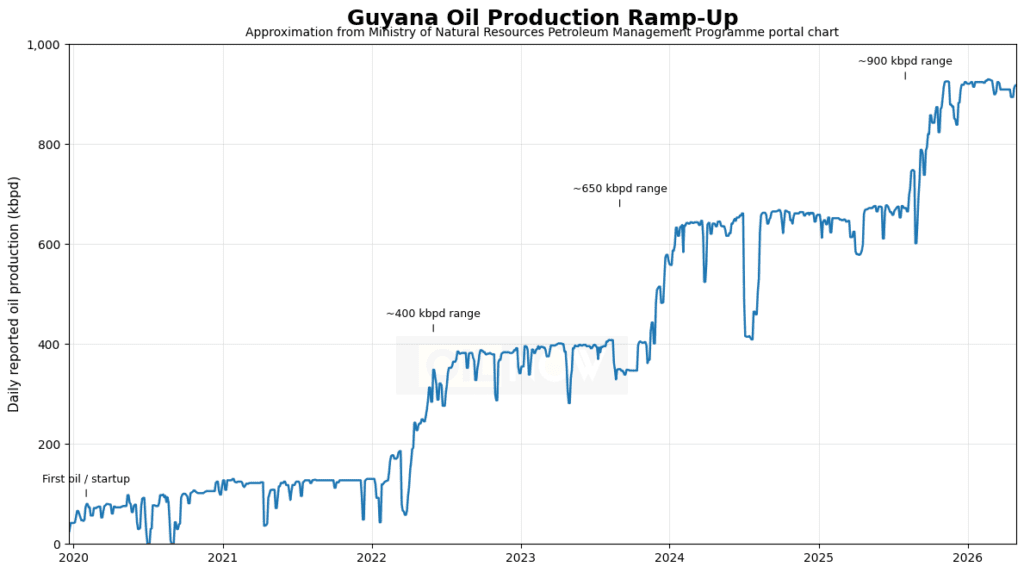
An OilNOW analysis of daily reported production data from the Ministry of Natural Resources shows the country’s output rising in large steps, rather than gradually. Production moved from startup volumes in 2020 to roughly 100,000 barrels per day by 2021, then climbed toward the 400,000-barrels-per-day range in 2022. Another major increase followed in 2023, lifting output into the 600,000-barrels-per-day range, before the latest surge pushed production to just over 900,000 barrels per day.
Rystad Energy sees up to 90,000 b/d upside from debottlenecking at future Stabroek Block projects
On a straight-line basis, the increase works out to an average addition of about 140,000 barrels per day each year since first oil. But the data tells a more important story: Guyana’s production has expanded through major project-led jumps, with each new floating production, storage and offloading vessel adding another large block of capacity.
That pace is globally significant. Many established petroleum provinces took decades to reach the scale Guyana has achieved in a little over six years. Guyana’s case is even more unusual because it is not expanding a mature oil base; it is building a national petroleum industry almost entirely from zero.
Payara still leads ExxonMobil’s record-breaking ramp-up offshore Guyana
The Stabroek Block, operated by ExxonMobil Guyana with partners Hess and CNOOC, has been the engine of the ramp-up. By early 2023, production from the first two fields was already nearly 400,000 barrels per day. Subsequent projects have continued to lift national capacity, with the Whiptail development expected to add about 250,000 barrels per day by the end of 2027 and bring Guyana’s total production capacity to about 1.3 million barrels per day.
The global comparison is stark. Guyana has gone from no commercial oil production to output levels comparable with, or higher than, several long-established producing countries. It has also become one of the key non-OPEC growth stories at a time when the global market is closely watching supply additions from the Americas, including the United States, Canada, Brazil and Guyana. The International Energy Agency has identified those countries as major drivers of non-OPEC+ supply growth.
Oil exports anchor Guyana’s trade ties with Europe, U.S. and Panama in 2025
The pattern visible in the Ministry data reflects the nature of deepwater development. Production does not rise smoothly every month. It climbs sharply when new FPSOs are commissioned, then stabilizes at a higher plateau. The chart also shows short downward movements, which are typical of offshore operations and may reflect maintenance, operational interruptions, field management, or reporting effects.
For Guyana, the scale and speed of the ramp-up carry major implications. Higher production is strengthening export earnings, government revenue and the country’s strategic importance in global energy supply. But the pace also increases pressure on public institutions, infrastructure, local content capacity, environmental oversight and long-term fiscal management.
The key takeaway is that Guyana has compressed decades of oil-sector growth into a few years. With more sanctioned Stabroek Block projects still to come, the country is moving rapidly from new producer to major global supplier.