
Guyana’s Natural Resource Fund is the country’s sovereign wealth fund. It is the legal vehicle through which revenues from oil production are collected, saved, and transferred into the national budget.
All government earnings from offshore petroleum production flow first into the fund before any portion can be spent.
The fund is governed by the Natural Resource Fund Act 2021 and is tapped for funding when Guyana plans its annual budgets. The law provides for a board of directors, oversight bodies and investment rules. The fund’s importance lies in how much money is flowing in, how much is being withdrawn, and what role it now plays in financing public spending.
Why was it established?
The fund was created because Guyana expected large and sustained revenues from oil production, specifically from oil sales and royalties derived from the ExxonMobil-operated Stabroek Block projects. Before first oil in 2019, policymakers recognized that sudden inflows of foreign currency could overwhelm the economy and fuel wasteful spending if left unmanaged.
The Natural Resource Fund was therefore designed to impose a legal framework on how oil revenues are handled, ensuring they are transparently recorded, partially saved, and withdrawn in a structured way to support national development and macroeconomic stability.
When was it established?
The fund was established under legislation passed in 2019, ahead of first oil at ExxonMobil’s first development. That first version of the law introduced a complex withdrawal formula that was criticized for being difficult to understand and for concentrating discretion in the hands of the finance minister.
After a change of government in 2020, the law was revised and replaced in 2021. The new legislation simplified the withdrawal rule and established a board of directors to manage the fund.
Where is the money kept?
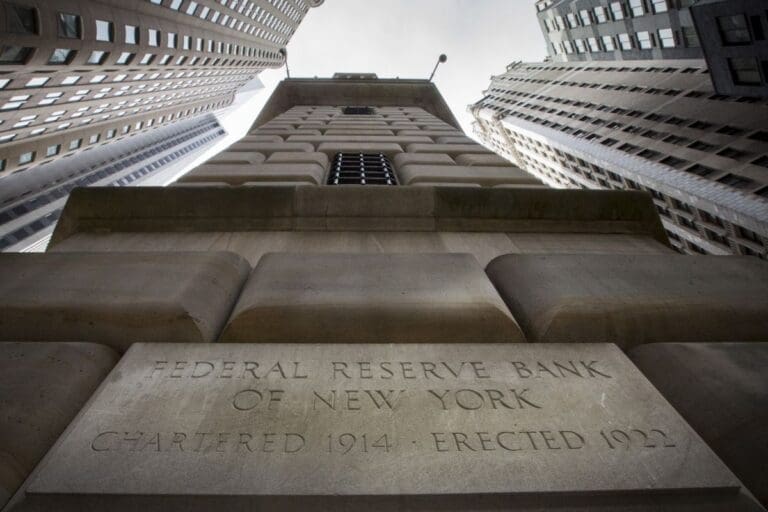
All monies in the Natural Resource Fund are held in an account at the Federal Reserve Bank of New York. This arrangement provides security, transparency, and international credibility, while insulating the funds from domestic political interference.
How much has Guyana withdrawn so far?
Since oil production began, withdrawals from the fund have increased steadily each year as production volumes and oil revenues have grown. In the early years, withdrawals were relatively modest. As Guyana moved from one producing project to multiple offshore developments, the amounts transferred to the budget expanded sharply.
To date, Guyana has withdrawn approximately US$5 billion from its Natural Resource Fund.
How does the withdrawal rule work?
The withdrawal rule is designed to scale up spending in line with revenue growth. In simple terms, as more oil money flows into the fund, the government is allowed to withdraw more.
The current formula links annual withdrawals to the total deposit into the fund from the previous year, while still retaining a portion of earnings for future years. Each increase in oil revenue therefore expands the amount available for public spending, rather than locking the country into a fixed cap.
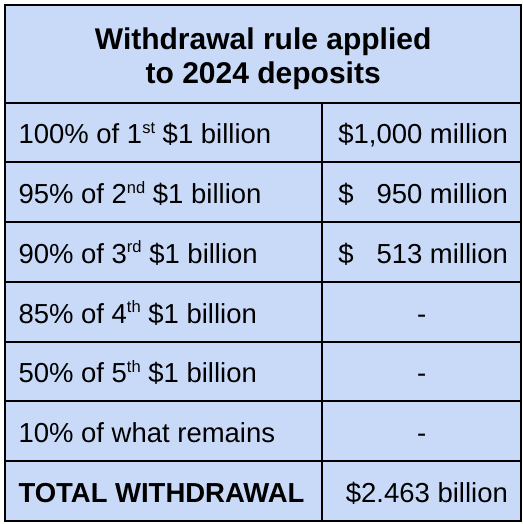
Table shows application of withdrawal rule to 2024 deposits to determine 2025 withdrawal
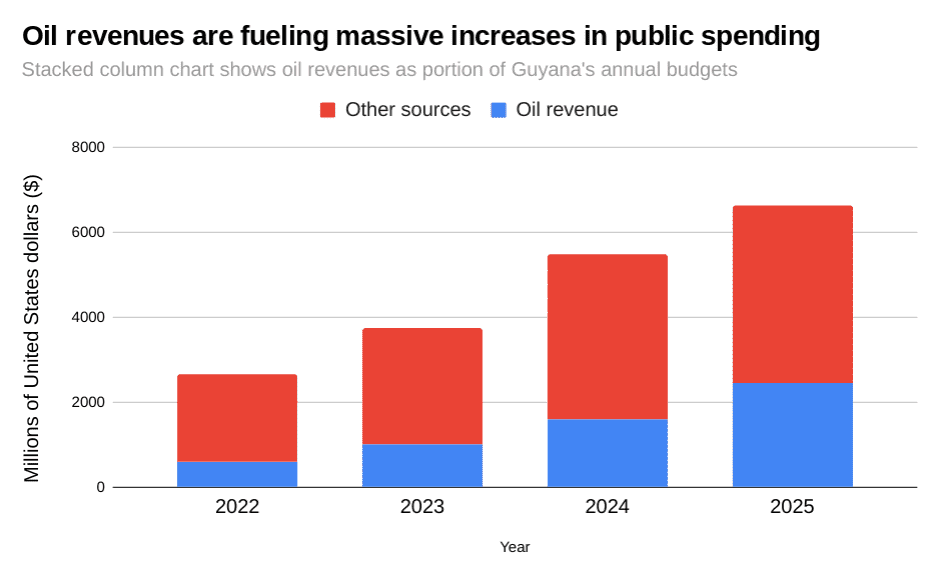
What share of the national budget does the fund now support?
The Natural Resource Fund now finances a substantial share of Guyana’s annual budget. In recent years, oil fund withdrawals have accounted for a significant and growing percentage of total government spending.
In 2022, the first year Guyana spent from the fund, oil revenues contributed 14% of the budget. By 2025, the contribution jumped to 37%.
As oil production has expanded, the fund’s contribution has shifted from supplementary financing to a central pillar of fiscal policy, underpinning largescale public investment programs and recurrent expenditure.
What is the money being spent on?
The government says oil revenues are being used both to build long-term productive capacity and to improve living standards. A large share of spending is directed toward infrastructure, including roads, bridges, ports, energy projects, hospitals, schools, and housing developments.
At the same time, part of the revenue is used for social spending, such as cash grants, public sector wage increases, subsidies, and expanded access to health and education services. The stated objective is to balance investment for future growth with immediate improvements in the quality of life for Guyanese citizens.
As withdrawals from the Natural Resource Fund grow, how effectively these resources are translated into durable development outcomes remains one of the central economic and political questions facing Guyana.