

The floating production, storage and offloading (FPSO) vessels operating offshore Guyana may be the most visible part of the nation’s oil industry, but production begins thousands of feet below the ocean surface through a complex network of wells, subsea equipment and pipelines installed on the seabed.
These critical pieces of infrastructure allow ExxonMobil, Guyana’s main operator, to safely extract, control and transport oil, gas and water from fields within the Stabroek Block.
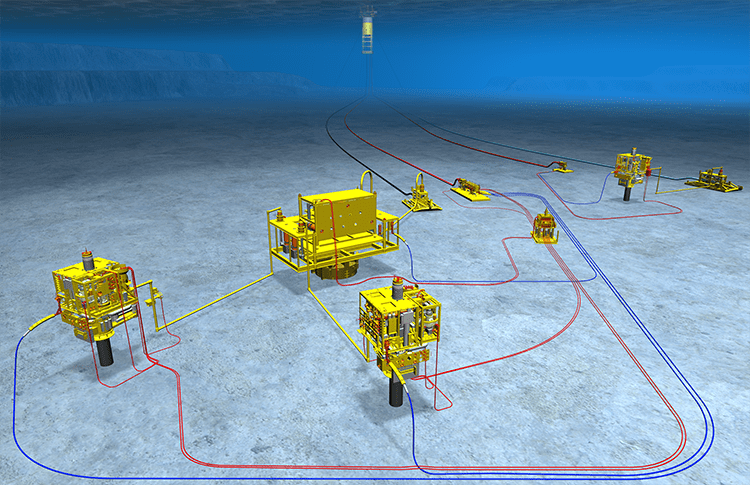
A major part of the subsea production system is known as SURF (subsea, umbilicals, risers and flowlines), which is used to transport hydrocarbons and remotely operate subsea facilities.
The role and functions of the subsea production system
- Subsea wells – Wells drilled into oil-bearing rock beneath the seafloor. They provide the path that allows oil and gas to flow from the reservoir into the offshore production system.
- Subsea trees – An assembly of valves and fittings installed on top of each subsea well. They control the flow of oil and gas from the well to the FPSO, regulate pressure, and allow operators to remotely monitor production and inject fluids into the well when needed.
- Subsea manifolds – Collect oil and gas from several wells and direct it into shared pipelines. This reduces the number of pipelines needed and helps keep production flowing efficiently.
- Flowlines – Pipelines laid along the seabed that transport oil, gas and water from wells and manifolds to the FPSO.
- Risers – Pipes that carry oil, gas and water from the seabed up to the FPSO, where the fluids are processed, stored and prepared for export.
- Umbilicals – Bundles of cables and hoses that carry electricity, hydraulic power, chemicals and communication signals from the FPSO to equipment on the seabed. They allow operators to monitor and control subsea equipment without sending people underwater.
- Pipeline end terminations (PLETs) – Structures that connect pipelines and flowlines on the seabed, allowing different parts of the subsea network to link together. In 2025, Saipem completed a PLET in-country for the Uaru development’s gas reinjection system.
Beyond SURF, operators also use subsea tiebacks as a field development strategy:
- Subsea tiebacks – A development method that connects a new oil or gas discovery to an existing FPSO instead of building a separate production facility. The system uses subsea wells, pipelines and other seabed equipment to transport production to the host FPSO for processing, storage and export. By using existing offshore infrastructure, tiebacks can reduce development costs and allow discoveries to be brought into production faster. In Guyana, Pacora is tied back to Payara, while Redtail, Mako and Snoek are being developed through the Yellowtail and Uaru projects.
Why subsea infrastructure matters
The scale of the subsea network grows with each development. Liza 1 was built around 17 development wells, Liza 2 expanded that to 30 wells, and Payara includes 41 wells. Future projects are even larger, with Yellowtail expected to require approximately 41 to 67 development wells and Uaru approximately 38 to 63 wells.
ExxonMobil Guyana President Alistair Routledge previously noted that approximately two-thirds of offshore development costs are associated with wells and subsea infrastructure.
The complexity of these systems has also created demand for specialized offshore contractors.
Companies including TechnipFMC, SLB and other subsea service providers handle the engineering, manufacture and installation of equipment used across Stabroek Block projects.
TechnipFMC has said Guyana’s subsea buildout is approaching the scale of major offshore regions, including the Gulf of Mexico, as additional projects like Yellowtail and Uaru move forward.
ExxonMobil operates Guyana’s Stabroek Block with a 45% stake, with co-venturers Hess (30%) and CNOOC (25%). The oil major has discovered an estimated 11 billion oil-equivalent barrels there.