



ExxonMobil Guyana President Alistair Routledge said the country’s long-term prosperity will depend less on physical infrastructure and more on developing human capability, as the company outlined details of its US$100 million, 10-year STEM education investment.
In a February 24 release, Routledge drew a parallel between energy infrastructure and education, stating, “The pipeline that matters most for Guyana’s future won’t carry oil or natural gas. It will carry talent.”
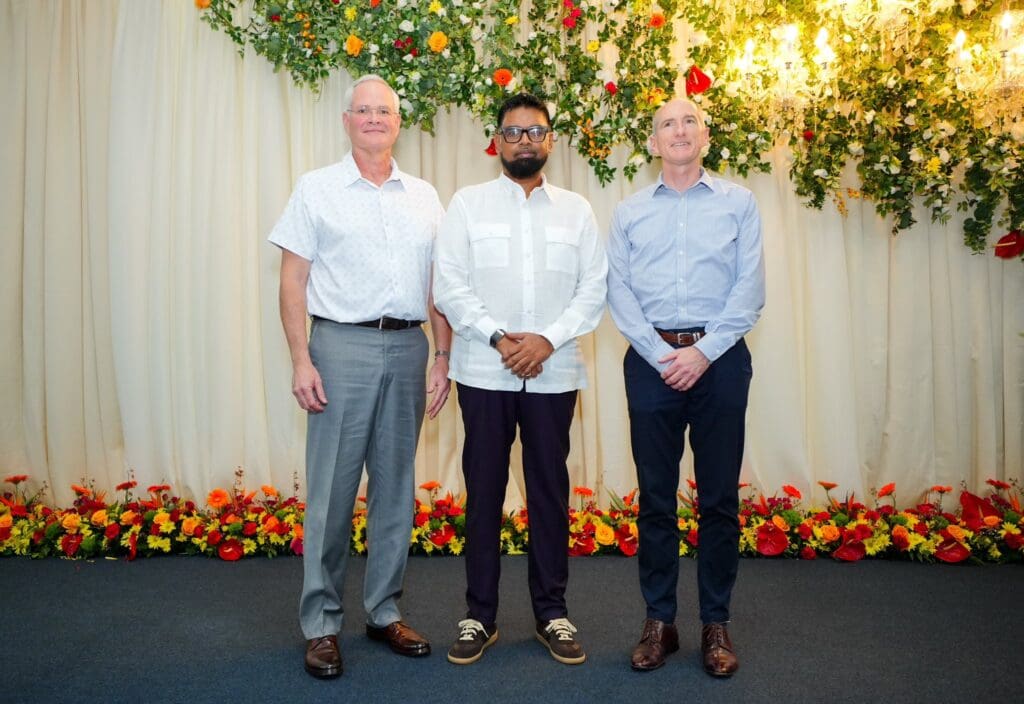
ExxonMobil Chief Executive Officer Darren Woods and President Irfaan Ali joined Routledge at State House to present the initiative, which is structured around teacher training, expanded student access to STEM resources, and clearer pathways to college and careers.
Routledge said pipelines are central to ExxonMobil’s operations, pointing to the 220-kilometer Gas-to-Energy pipeline that was recently constructed and is awaiting completion of the power plant. But he emphasized that Guyana’s next phase of development hinges on building a domestic talent base.
“That belief is at the core of the Guyana STEM Initiative – a $100 million, decade-long investment by ExxonMobil, to strengthen Science, Technology, Engineering, and Math education across the country,” he stated.
The first pillar focuses on strengthening STEM teaching. Starting in September, the ExxonMobil Foundation will partner with the Ministry of Education, the University of Guyana and the University of Houston to deliver Teacher STEM Training. Routledge noted, “Decades of experience show that teacher preparation is one of the strongest predictors of student success.”
The second pillar targets student access. Over the next decade, programs will expand inside and outside classrooms. World-class resources, including Khan Academy, will be introduced nationwide, including in hinterland communities. The initiative also includes the creation of a network of STEM Centres and satellites, operated by the ExxonMobil Foundation, with the first opening planned for 2029 in Georgetown.
The third pillar centers on career readiness. In addition to hands-on learning, the program will provide pre-college math and science courses, transition support, mentoring and tutoring. Routledge stated, “Because when learning is tied to real-world opportunity, ambition becomes attainable.”
Routledge added that while offshore discoveries altered Guyana’s economic trajectory a decade ago, the country’s future will be shaped in classrooms. “After all, Guyana’s greatest resource isn’t the oil and gas that lies buried beneath the seabed, but the human capital found in its classrooms around the country,” he said.