
Two major offshore oil stories have unfolded on opposite sides of the Guyana-Suriname Basin, but the distance between discovery and production has been very different.
Guyana went from the Liza discovery in May 2015 to first oil in December 2019, less than five years later. Its first final investment decision (FID) came in 2017, setting the country on a development path that would lead to four producing projects within a decade.
Suriname’s Maka Central discovery came in January 2020, but its first offshore project, GranMorgu, did not reach FID until October 2024. First oil is expected in 2028.
The difference is not that the two countries followed completely different development processes. Both had to move through exploration, appraisal, environmental and development planning, regulatory approvals, FID, construction and installation. The bigger difference was how quickly the oil operators moved through those stages and, in Suriname’s case, how long it took to establish the commercial basis for the first development.
The timelines at a glance
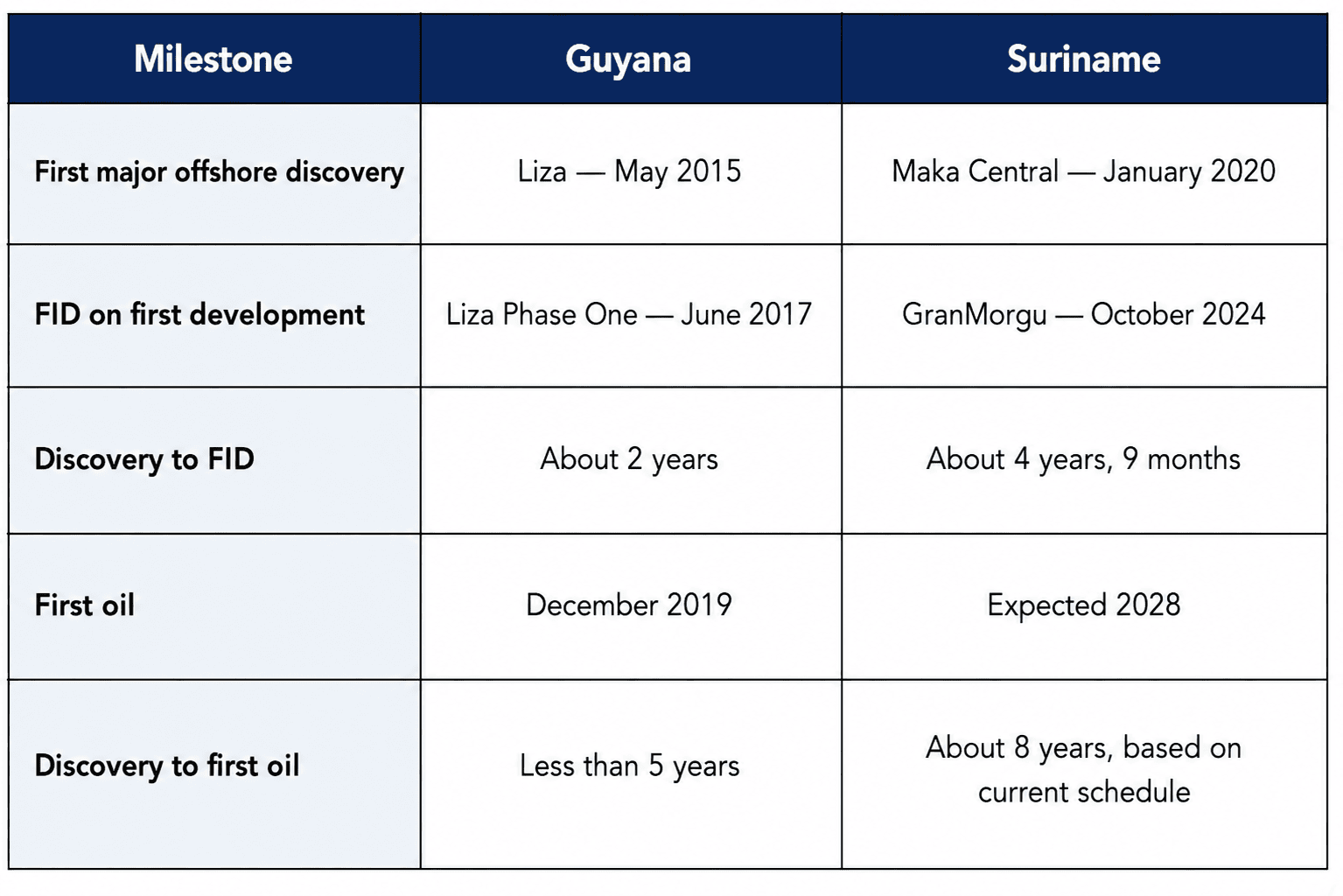
Note: The comparison uses Liza as Guyana’s first major offshore oil discovery and Maka Central as the first major discovery in Suriname’s Block 58. GranMorgu is based on the Sapakara and Krabdagu discoveries.
Guyana moved quickly after Liza
ExxonMobil announced the Liza discovery in May 2015. Appraisal and development planning followed, and by June 2017, Liza 1 had received its development approval, production license and FID.
The project then moved into construction, with the Liza Destiny floating production, storage and offloading (FPSO) vessel arriving offshore Guyana in 2019. Production began in December that year.
The pace continued after Liza. ExxonMobil and its Stabroek Block co-venturers sanctioned Payara in 2020, Yellowtail in 2022, Uaru in 2023 and Whiptail in 2024. This allowed development work on multiple projects to overlap, with discoveries also being incorporated into existing production hubs through subsea tiebacks.
ExxonMobil operates the Block with a 45% interest, alongside Hess (owned by Chevron) with 30% and CNOOC with 25%
Suriname took longer to define its first project
Suriname’s Block 58 produced a series of discoveries after Maka Central, including Sapakara West, Kwaskwasi and Keskesi, followed by Krabdagu. But the discoveries did not immediately translate into a development decision.
TotalEnergies continued exploration and appraisal to determine whether the resource base was large enough to support a commercial first development. After the Krabdagu discovery in February 2022, the company said its strategy was to identify sufficient resources for a first oil development by the end of that year.
The turning point came with the appraisal of Sapakara South and Krabdagu. Completed in August 2023, the campaign confirmed nearly 700 million barrels of combined recoverable resources. TotalEnergies then began development studies for a project targeting 200,000 barrels of oil per day, with FID planned for the end of 2024.
That development work also had to establish that the project could support the required investment. TotalEnergies later put GranMorgu’s estimated capital cost at about US$10.5 billion and its expected return at about 15% at an oil price of US$60 per barrel.
Once those decisions were made, the final approval stage moved quickly. Staatsolie approved the GranMorgu field development plan on September 30, 2024, and TotalEnergies announced FID the following day.
GranMorgu will develop the Sapakara and Krabdagu discoveries through an FPSO with a production capacity of 220,000 barrels of oil per day. TotalEnergies operates Block 58 with APA Corporation and Staatsolie Maatschappij Suriname N.V. as partners, and first oil is expected in 2028. In the case of the GranMorgu project, Staatsolie has exercised a right to take a 20% stake, while TotalEnergies and APA each hold 40%.