
Guyana’s oil production fell in May and again in June, according to government data. ExxonMobil leads a consortium that has invested more than US$50 billion to explore and develop the resource offshore.
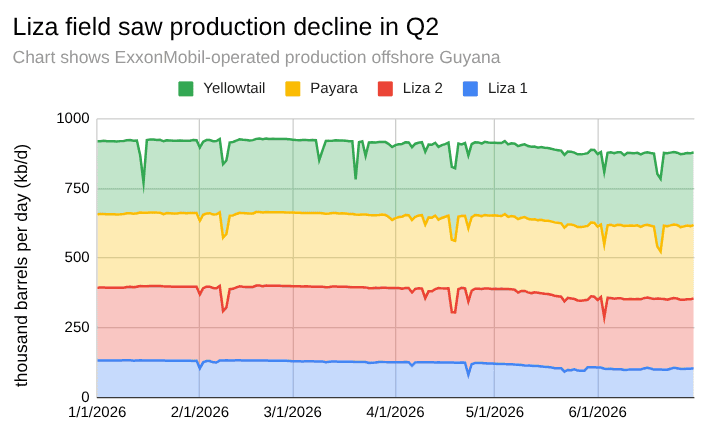
Production averaged 869,000 barrels per day (b/d) in June. This was down from 895,000 b/d in May and 902,000 b/d in April. From April to June, production fell by about 34,000 b/d.
Most of the decline came from the Liza projects.
Liza 1 produced an average 122,000 b/d in April. This fell to 108,000 b/d in May and 101,000 b/d in June.
Liza 2 averaged 259,000 b/d in April and 261,000 b/d in May. Production then fell to 250,000 b/d in June.
Output from Payara and Yellowtail was more stable. Each generally produced between 257,000 b/d and 264,000 b/d during the three-month period.
Guyana earns almost US$2B from oil in first half of 2026
Exxon had started the year with 915,000 b/d in January, but given the decline, Guyana averaged about 902,000 b/d in the first half of 2026.
The production decline comes as Guyana is beginning to receive a larger share of the oil produced offshore.
The Stabroek Block Petroleum Agreement allows the contractors to use up to 75% of monthly production to recover expenses. The remaining oil is considered profit oil and is divided equally between the government and the contractors.
When the full 75% is used for cost recovery, Guyana receives 12.5% of total production as profit oil.
But the contractors no longer need to use the full 75%.
ExxonMobil has said about US$55 billion in investments, along with a substantial amount of operating expenses, have been recovered. This happened about two years earlier than expected.
This means less oil is needed to recover past expenses. More of the production can therefore be divided as profit oil, giving Guyana more barrels to sell.
This will not remain fixed.
The contractors continue to incur operating and exploration expenses. Hammerhead is also under development. More costs will be added when projects such as Longtail and Haimara are approved and developed.
The amount of oil used for cost recovery can therefore increase again.
For now, however, Guyana is receiving a much larger share of production than the 12.5% it received when the full cost recovery ceiling was being used.
The change could have a major effect on the Natural Resource Fund.
Guyana receives its share of profit oil in physical cargoes, which the government sells. A larger share of production means more government cargoes and more oil revenue.
This is happening while oil prices are high because of the conflict in the Middle East, including developments around the Strait of Hormuz.
Guyana is therefore benefiting in two ways. It is receiving more barrels, and each cargo can be sold for more money.
This also makes the government’s original 2026 petroleum revenue forecast increasingly conservative.
At the beginning of the year, the government projected about US$2.7 billion in oil sales and royalties for 2026. That estimate was made before the current combination of higher oil prices and a larger government share of production.
Production capacity is also set to increase again before the end of the year.
The Errea Wittu floating production, storage and offloading vessel is on its way to Guyana for the Uaru project. ExxonMobil has said the project remains on track to start production by year-end.
Uaru will add capacity of about 250,000 b/d. This will take Guyana’s total production capacity above 1.1 million b/d.
The additional production will provide another source of oil for both cost recovery and profit oil.
All of Guyana’s offshore production comes from the Stabroek Block. ExxonMobil operates the block with a 45% interest. Chevron, through Hess, holds 30%, while CNOOC holds 25%.
The decline from 902,000 b/d in April to 869,000 b/d in June is notable. But production alone does not give the full picture of what is happening with Guyana’s oil revenues.
Guyana is getting a larger share of the oil. Prices are higher. And another major project is expected to start producing before the year ends.
Those three factors put the country on track to earn considerably more from oil in 2026 than initially projected.
Guyana’s Oil Ledger offers analyses of the latest oil production data and government oil fund receipts, published typically on a fortnightly basis. The column is authored by Kemol King, a journalist specializing in Guyana’s oil and gas sector.