


Guyana’s offshore oil isn’t just abundant; it also carries chemical traits that make it desirable to refiners around the world. From its early discoveries in 2019 to today’s steadily rising exports, the quality of Guyana’s crude has helped the young but rapidly growing energy producer secure attention and contracts in global oil markets. But what exactly makes one barrel of oil more attractive than another?
Have you ever wondered what industry experts mean when they talk about “light,” “sweet,” or “medium” crude? And where does Guyana’s oil fit in? Let’s unpack the science and see why Guyana’s barrels are finding markets far beyond its shores.
Sweet vs. sour: understanding crude chemistry
Crude oil grades are shaped by two key measurements: sulfur content and API gravity. Together, these traits help define whether a crude is light or heavy, sweet or sour — and influence how easy it is to refine into high-value products like gasoline and diesel.
Sweet crude refers to oil with low sulfur content, generally less than about 0.5% by weight. Lower sulfur makes oil less corrosive to refinery equipment and reduces the need for costly desulfurization during refining. Sweet crude usually yields more clean-burning fuels, making it a favorite among many buyers. Crudes with higher sulfur levels are considered sour and typically require more processing to meet product quality and environmental standards.
API gravity: the scale that matters
Another essential metric is API gravity, developed by the American Petroleum Institute (API), which measures how light or heavy crude oil is relative to water. The scale helps classify oil from extra-heavy to light:
Higher API gravity means lighter oil, which tends to produce a higher proportion of high-value fuels.
Lower API gravity means heavier oil, which can require more complex refining.
API gravity is measured in degrees (°): crude above 31° API is typically considered light; 25-31° API falls into the medium range. This scale helps buyers and refiners quickly assess how crude will behave in a refinery.
Where Guyana’s crudes sit on the grade map
Guyana’s oil grades, produced from the prolific Stabroek Block operated by ExxonMobil Guyana and co-venturers, generally fall into the medium-sweet category on the quality spectrum.
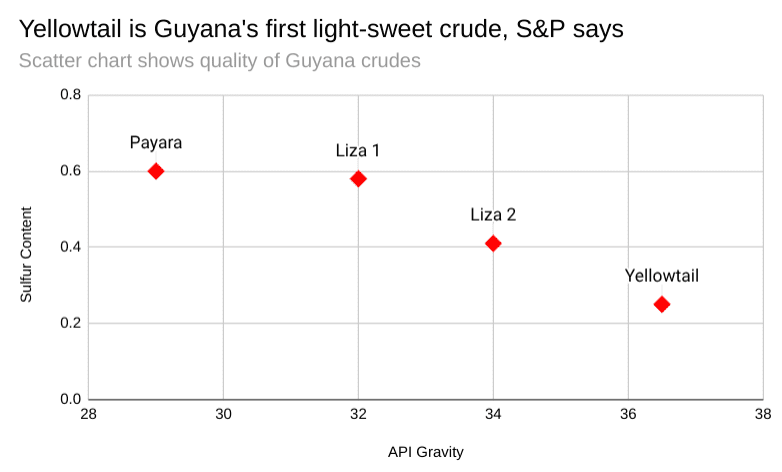
The first crude exported from Guyana, known as Liza crude, has an API gravity of about 32° with moderate sulfur levels — characteristics that place it in the medium-sweet bracket and make it compatible with many refinery designs worldwide.
Subsequent grades such as Unity Gold and Payara Gold have similar profiles, with Unity Gold typically showing higher API values and low sulfur, while Payara Gold is slightly lower in API gravity but still qualifies as medium-sweet. These traits help them attract buyers in Europe and beyond. Yellowtail’s Golden Arrowhead, however, is the first light sweet crude produced offshore Guyana, with API gravity of 36.5°.
Quality and market appeal
Why does this matter? Refineries are engineered to process specific types of crude. Many modern facilities, especially in Europe and the United States, are optimized for light to medium sweet crudes, which yield a higher percentage of gasoline, diesel, and other valuable products with less processing. Guyana’s grades fit well into these systems, reducing the refiners’ need for complex processing units and lowering costs.
Guyana crude makes trade debut on Platts | OilNOW
That has helped Guyanese barrels gain traction in key export markets. For example, recent trade shows steady demand for Liza, Unity Gold, Payara Gold and Golden Arrowhead in European markets that increasingly favor easier-to-process oil over heavier, sour grades from other regions.
Standards, testing, and confidence
Accurate quality measurement and testing underpin the credibility of these crude grades. The Guyana National Bureau of Standards (GNBS) plays a crucial role in confirming crude characteristics — such as density, sulfur, and other parameters — to ensure compliance with international norms. GNBS testing follows API standards and helps verify that each cargo matches its marketed grade.
This quality assurance builds confidence among buyers and helps Guyana establish reliable, long-term relationships in the global oil market.
The world still needs a mix of crude types — from light and sweet to heavy and sour — because not all refineries are the same. But crude that sits in that sweet spot of low sulfur and favorable API gravity often moves more easily through global supply chains and yields more of the fuels that power transportation and industry.
Exxon, Chevron and BP among 27 bidders for Guyana crude marketing deal | OilNOW
Guyana’s success in producing medium sweet crude has helped the country secure export markets quickly, diversify buyers, and carve out a strong position in the global energy landscape.