


Guyana’s rapid offshore production growth is unfolding against a more cautious global exploration backdrop, with Westwood Global Energy Group reporting that high-impact exploration drilling fell to its lowest annual level on record in 2025.
In its State of Exploration 2026 insight, Westwood said just 64 high-impact wells were completed globally in 2025, a 17% decline from 2024 and the lowest annual total it has recorded since 2008.
The wells delivered 4.8 billion barrels of oil equivalent of discovered resource at a 31% commercial success rate, a slight improvement on the 28% to 29% success rates recorded in 2023 and 2024.
The findings provide important context for Guyana, where the ExxonMobil-operated Stabroek Block has already moved from frontier discovery to large-scale production. OilNOW has reported that production from the block exceeded 900,000 barrels per day by the end of 2025, supported by four producing FPSOs: Liza Destiny, Liza Unity, Prosperity and ONE GUYANA.
Guyana recorded 260 crude oil lifts in 2025 from those four vessels, including 32 government entitlement lifts. ExxonMobil Guyana, which holds a 45% operating interest in the block, recorded 102 crude lifts from its share, generating US$8.1 billion in revenue for the year.
Westwood’s report underscores why Guyana remains important in the global exploration conversation. At a time when fewer high-impact wells are being drilled worldwide, Guyana has already converted a string of major discoveries into one of the fastest-growing offshore production hubs.
ExxonMobil Guyana finds among top discoveries shaping global oil exploration — Wood Mackenzie
But Westwood also points to a changing phase for the wider Guyana-Suriname basin. It said frontier exploration is not renewing the emerging play opportunity set fast enough, with frontier play drilling steady in recent years but commercial success rates averaging just 13% over the last five years.
Westwood identified the Upper Cretaceous in Guyana-Suriname as one of the previously significant plays now maturing. That assessment suggests the basin remains highly important, but the exploration story is shifting from early play-opening success toward more selective drilling, appraisal, development and resource optimization.
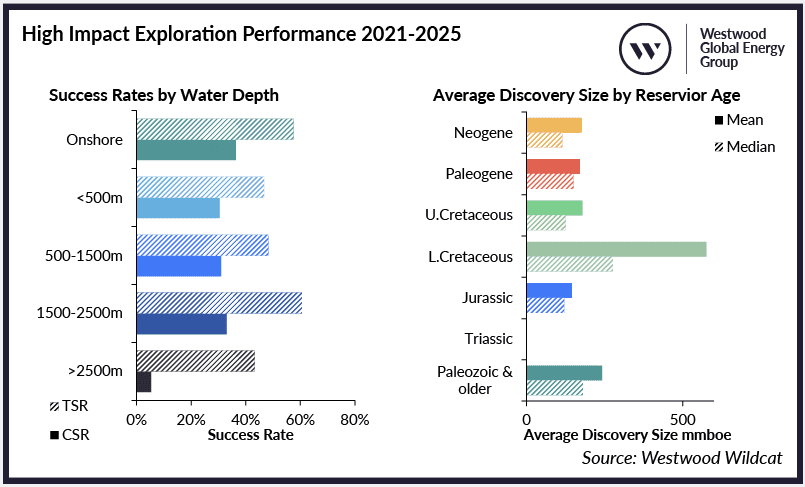
Globally, Westwood said 373 high-impact wells drilled from 2021 to 2025 delivered approximately 29 billion barrels of oil equivalent of potentially commercial resource at a 30% commercial success rate. The firm said exploration has moved further into deeper water, with ultra-deepwater wells accounting for 16% of wells drilled in 2025.
However, ultra-deepwater exploration has remained challenging. Westwood said only two of 37 ultra-deepwater wells completed between 2021 and 2025 resulted in commercial discoveries, despite technical success rates being broadly in line with other water depths.
Cretaceous plays dominated high-impact exploration over the five-year period, accounting for 46% of primary targets in wells drilled and 65% of discovered resource. Westwood said Lower Cretaceous plays delivered the largest share of Cretaceous resources and significantly larger discoveries than other reservoir ages.
The company also found that high-impact exploration remains concentrated among a relatively small group of companies. Between 2021 and 2025, 173 companies participated in high-impact wells, but only 10 drilled 25 or more wells during the period. Supermajors and national oil companies accounted for eight of the 10 most active explorers and held 65% of high-impact well equity in 2025.
TotalEnergies plans second wave of Suriname exploration from 2027
Among companies, Westwood said ExxonMobil led the supermajors with a 38% commercial success rate over the 2021–2025 period. It also reported that Hess and CNOOC, Exxon’s Stabroek Block partners, delivered some of the highest commercial success rates among the most active explorers, at 51% and 58%, respectively.
For Guyana, the report reinforces both the scale of what has already been achieved and the strategic importance of sustaining exploration discipline. The country’s production base is expanding rapidly, but Westwood’s analysis shows that globally, large new discoveries are becoming harder to capture, especially in frontier and ultra-deepwater settings.
That makes continued appraisal, reservoir understanding, project execution and careful exploration targeting increasingly important for the next phase of Guyana’s offshore development.