
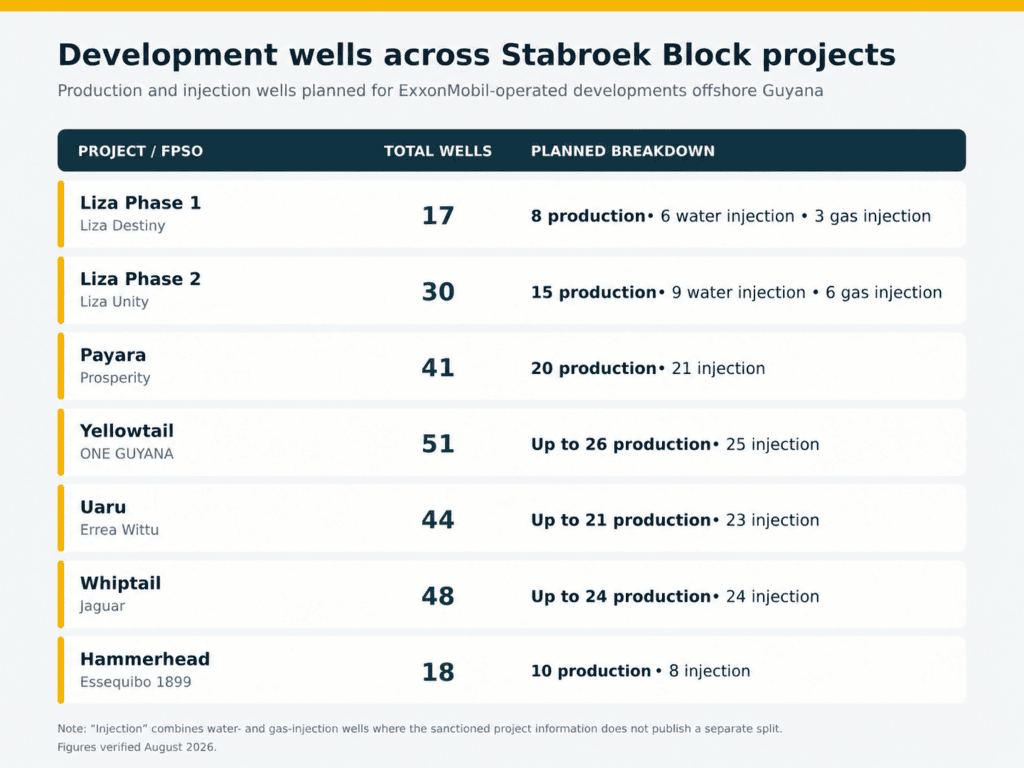
Guyana’s seven approved Stabroek Block developments are expected to use as many as 249 development wells, but not all of them will be producing oil.
The wells fall into three main categories — production, water injection and gas injection — with production wells bringing reservoir fluids to the surface, while injection wells support oil recovery by managing pressure and fluid movement within the reservoir.
But first, what is a development well?
According to ExxonMobil, a development well is drilled in an area where hydrocarbons have already been discovered. More broadly, development wells form part of the system used to produce oil and gas from a discovered reservoir and can include both production and injection wells.
In Guyana, this means the well forms part of an offshore development that has received the necessary government and environmental approvals to move from discovery to production. For example, ExxonMobil’s Liza 1 received a production license and environmental authorization in 2017 before development wells were drilled as part of the project.
Exxon lines up 35-well Stabroek drilling push as Guyana oil search stretches to 2033 | OilNOW
Production wells bring oil and gas to the surface
Production wells are the most direct part of the system. They are drilled into the reservoir to bring hydrocarbons to the surface, where the oil and gas can be processed aboard the floating production, storage and offloading (FPSO) vessel.
ExxonMobil’s project plans indicate that there are 249 development wells among the seven Stabroek Block developments.
But production wells are only part of how the fields are developed.
Supporting recovery with water
Water injection wells send water into the reservoir rather than bringing hydrocarbons out.
According to oilfield services company SLB, water injection can help replace produced fluids, maintain reservoir pressure and push oil toward production wells. The water-injection well itself does not produce oil; its role is to support recovery from surrounding production wells.
This is why some Stabroek developments have almost as many water injection wells as production wells.
Putting gas back into the reservoir
Gas injection works much like water injection, but gas is put back into the underground formation instead of water. SLB’s 2015 Oilfield Review explains that injected gas can help maintain reservoir pressure and support the movement of oil toward production wells.
In Guyana’s offshore developments, production wells bring reservoir fluids to the FPSO, where the oil, gas and water are separated and processed. Injection wells serve a different function within the development: they put water or gas back into the formation to support pressure and improve oil recovery.
Why the distinction matters
Together, the wells form a connected development system: production wells bring hydrocarbons out, while injection wells help create the conditions for more oil to be recovered.
This means the total number of development wells in a Stabroek Block project does not represent the number of wells producing oil.