
A series of major developments is expected to shape Guyana’s oil and gas sector in 2026, as production rises and long-planned projects and decisions come due.
Potential ICJ ruling on the Guyana/Venezuela border case
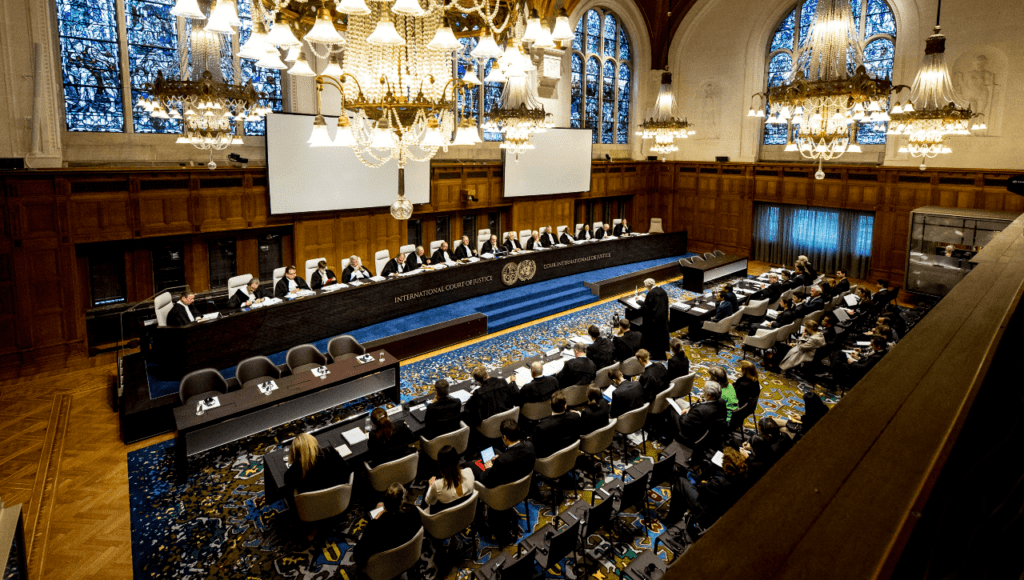
Guyana could receive a long-awaited ruling from the International Court of Justice (ICJ) in 2026 on the validity of the 1899 Arbitral Award, which established the boundary with Venezuela. Carl Greenidge, Guyana’s agent to the Court, has indicated that a final decision is possible during the year, offering long-sought clarity in a controversy that has persisted for decades. The case was referred to the ICJ by the UN Secretary-General under the Geneva Agreement framework, the mechanism both countries agreed to use to resolve the controversy.
Oil production set to exceed one million barrels per day
Guyana’s oil production capacity is set to cross the one-million-barrel-per-day mark in late 2026, driven by the start-up of the Uaru project, the country’s fifth offshore oil development. Production reached 900,000 barrels per day in November 2025 following the addition of Yellowtail, and Uaru is expected to add another 250,000 barrels per day, pushing national output to roughly 1.15 million barrels per day or higher. Central to this ramp-up will be the completion and arrival of the Errea Wittu FPSO, which will be installed at the Uaru field ahead of first oil.
Yellowtail production optimization
ExxonMobil is also expected to pursue optimization activities at the Yellowtail development in 2026, following its rapid ramp-up to roughly 250,000 barrels per day in November 2025. While the company has not disclosed a target for post-optimization output, its past debottlenecking work at earlier Stabroek Block projects yielded average gains of about 45,000 barrels per day per project.
ExxonMobil’s potential purchase of the ONE GUYANA FPSO
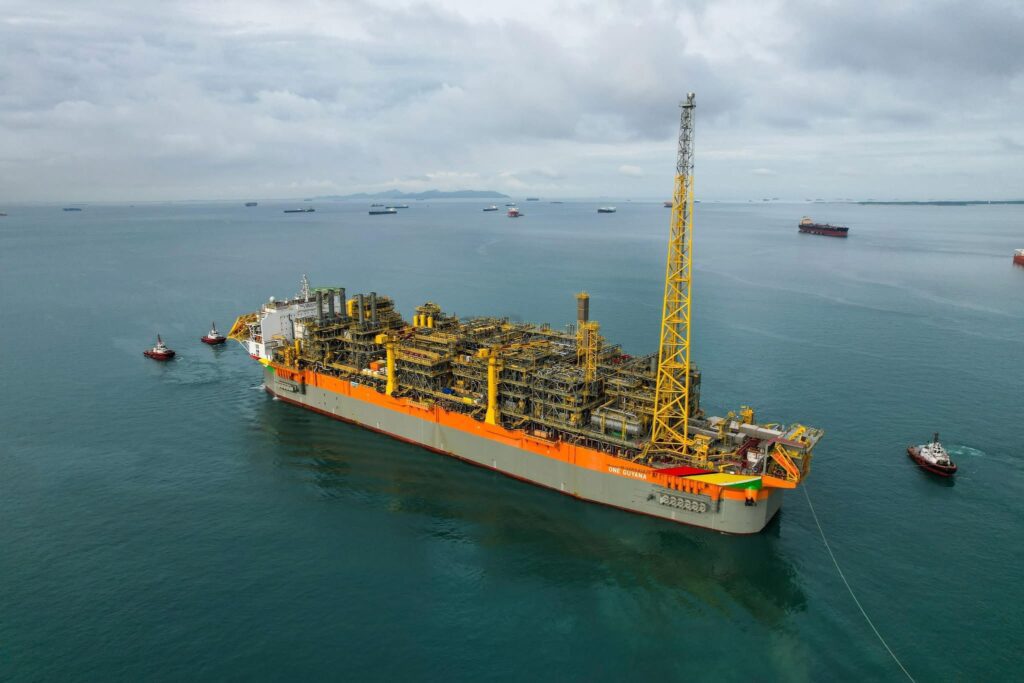
ExxonMobil has signalled its intention to purchase the ONE GUYANA FPSO from SBM Offshore, the vessel currently producing at the Yellowtail development. The company has already acquired the Liza Destiny, Liza Unity, and Prosperity units, and a similar transaction for the ONE GUYANA could be completed in 2026. A purchase would further consolidate Exxon’s ownership of the production fleet operating on the Stabroek Block.
Review and approval of the Longtail project
The proposed Longtail development is expected to undergo government review and potential approval in 2026, positioning it as ExxonMobil’s eighth offshore project and the first in Guyana to target non-associated gas. Unlike previous developments built around oil fields with associated gas, Longtail will tap into gas fields, with plans for condensate production of roughly 240,000 barrels per day and eventual gas output capacity approaching one billion cubic feet per day.
New production to boost state revenues
Higher production in 2026 is expected to push Guyana’s annual oil revenues past the US$3 billion mark, despite soft prices linked to a global supply glut. Rising volumes will bring continued growth in receipts from royalties and oil sales. The elevated production will also accelerate cost recovery for ExxonMobil and its partners, shortening the period in which they recoup their investment and hastening the point at which Guyana captures a larger share of profit oil.
Final phase of Stabroek Block exploration push
Exploration activity in the Stabroek Block is expected to continue in 2026, as ExxonMobil works to unlock additional upside beyond the 11 billion barrels of oil equivalent already discovered. With the block’s exploration licence set to expire in October 2027, the coming year marks the start of the final 20-month window to drill new prospects unless circumstances arise that permit an extension. Both companies have signalled confidence that more resources remain to be found, setting the stage for an aggressive exploration push before the clock runs out.

Studies and drilling at shallow-water Blocks S4 and S7
Two newly awarded shallow-water blocks — S4, operated by TotalEnergies with Petronas and QatarEnergy, and S7, held by Ghana’s Cybele Energy — are expected to enter the study phase in 2026, including seismic acquisition and other early-stage assessments. Both groups must submit and execute detailed work programs under the terms of their petroleum agreements, marking the start of exploration efforts to determine whether additional oil and gas resources lie in the Guyana basin, beyond the Stabroek Block.
Additional block awards and possible contract revision
Additional awards from Guyana’s first competitive offshore auction could materialize in 2026, as several bidding groups continue working to secure financing and align the partnerships needed to take on exploration commitments. The first two awards — Blocks S4 and S7 — were issued in late 2025, and the government has said that remaining bidders are still finalizing their commercial arrangements. At the same time, officials have indicated that the petroleum model contract may undergo another revision, potentially forming the basis for a second competitive auction. However, there is no clear signal yet on whether a new bidding round would be launched during the year.
Government-sanctioned seismic study of deepwater blocks
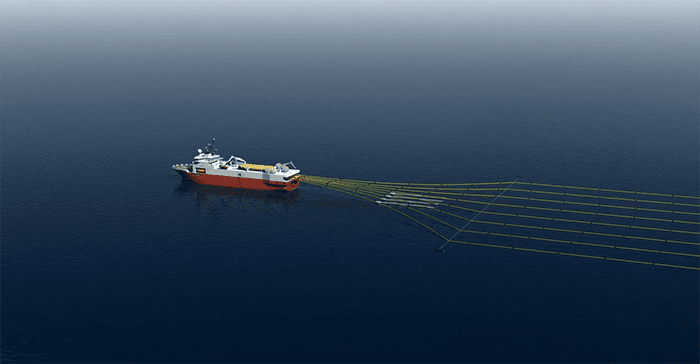
The Ministry of Natural Resources is sanctioning a 3D seismic study covering deepwater blocks that were left unawarded or unresolved in the country’s first offshore auction. Latitude Energy Inc., a Guyanese company operating in partnership with the UK-based Future Energy Consultants, will conduct the survey over blocks D1, D2 and D3. The project is expected to take 5.5 months and will cover 11,468 square kilometres.
Industrial ventures at Wales: NGL storage, fertilizer plant, and gas bottling
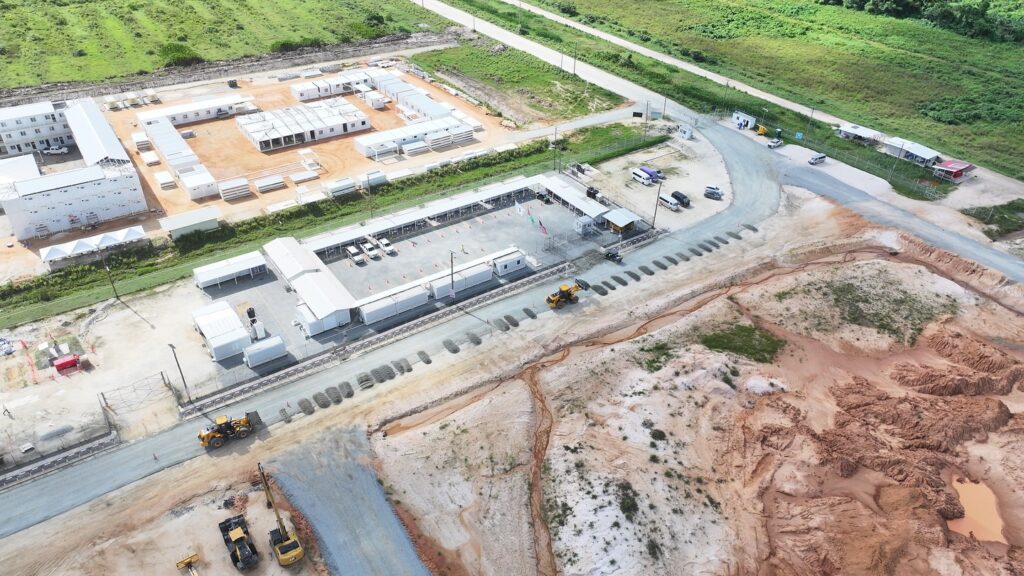
In 2026, the government is expected to advance several major industrial ventures tied to the Gas-to-Energy project, including contract awards for the natural gas liquids (NGL) storage and marine offloading facility, the ammonia and urea plant, and a new gas bottling company at Wales. The NGL facility will be central to Guyana’s ability to store and market natural gas liquids, providing the infrastructure to move product from onshore processing to the Demerara Channel, where it can be loaded onto vessels for sale. The planned ammonia and urea plant is intended to supply key inputs for the agriculture sector, supporting Guyana’s push to expand regional food production and lower costs for farmers. Meanwhile, a dedicated gas bottling company would allow the country to produce its own cooking gas at significantly lower prices. While no contracts have been awarded to date, the government has already issued calls for proposals. Bids for the NGL facility have been submitted, and proposals for the ammonia and urea plant and the gas bottling company are due in the first quarter of 2026.
Commissioning of the Gas-to-Energy Project
Guyana is expected to see the long-awaited commissioning of the Gas-to-Energy project in 2026, with the government now projecting the fourth quarter for completion of the onshore components, including the 300 MW gas-fired power plant and the NGL separation facility. The target remains tentative, after repeated delays that shifted the original end-2024 date several times, leaving uncertainty about whether further slippage may occur. ExxonMobil’s portion of the project — the offshore pipeline — was completed in 2024, placing the remaining focus on the onshore works. The project promises to cut power costs by half, ease chronic outages, and sharply reduce emissions. If delivered, these improvements would lift the competitiveness of multiple sectors, expand fiscal space, and strengthen Guyana’s broader push to position itself as a modern and globally competitive economy.